Deep machine learning explained: a clear guide for clients and freelancers
 Mark Petrenko
 What is deep machine learning?
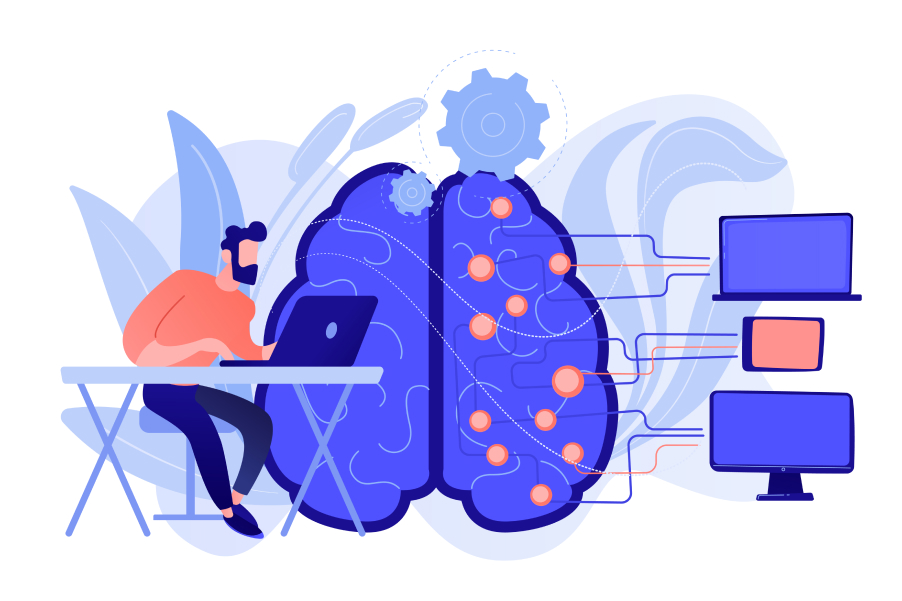
Deep machine learning — usually called deep learning — is a family of machine learning methods that train multi-layer neural networks to learn complex patterns from data such as images, text or audio. In practical terms, deep learning is a tool you reach for when the input is raw, unstructured data and simpler approaches struggle to recognise the patterns you need.
Think of artificial intelligence (AI) as the broad goal — machines doing tasks that normally need human intelligence. Machine learning (ML) is a way of building AI systems by letting models learn from data. Deep learning (DL) is a subset of ML that uses many stacked layers (hence “deep”) to learn hierarchical features automatically. That structure is why deep models often perform best on tasks like image recognition or conversational assistants.
How deep learning actually works — a high-level, non-technical look
At a conceptual level, a deep learning model is a large network of simple units (often called neurons) arranged in layers. During training the model sees examples and gradually adjusts internal connections (weights) so inputs map to the right outputs. Over many examples the layers learn to detect progressively higher-level features (for images: edges → shapes → objects; for text: words → phrases → intent).
There are two phases to keep in mind: training (teaching the model using labelled examples or large unsupervised corpora) and inference (using the trained model to make predictions). Two practical enablers of modern deep learning are backpropagation (the algorithm that updates weights during training) and GPUs (hardware that accelerates those updates).
Different problems use different building blocks: convolutional neural networks (CNNs) are common for images, and transformer-based models are now the standard for many text tasks. As a non-programmer, the most useful takeaway is this: deep models learn complex patterns automatically, but they usually need a lot of data and compute to do it well.
Where deep learning is useful (practical applications for freelancers and clients)
Choose deep learning when your project involves complex, unstructured data or you need state-of-the-art accuracy. Below are high-impact use cases that suit Swaplance clients and freelancers, with a simple example of what a freelancer might deliver.
- Image and video analysis — business value: automating inspection, tagging or visual search. Freelancer deliverable: a model that recognises specific objects in images and a small demo app that flags matches.
- Natural language processing (NLP) and chatbots — business value: reduce support costs and speed responses. Freelancer deliverable: fine-tune a pre-trained language model to power a customer-support bot that answers common queries and hands off complex cases to humans. See our piece on building chatbots with machine learning for practical design ideas.
- Personalisation and recommendations — business value: increase engagement and conversions. Freelancer deliverable: a recommender that ranks products or content using user behaviour and content features.
- Generative content (text, images, audio) — business value: scale content creation or creative prototyping. Freelancer deliverable: a controlled generator tuned for the brand voice or visual style with usage guidelines.
- Predictive analytics on complex signals — business value: better forecasting or anomaly detection when patterns are subtle. Freelancer deliverable: a prototype model and validation report showing business metrics improved by the model.
Do you actually need deep learning? A simple decision checklist
Before committing, run through this quick checklist. These are rules of thumb, not strict thresholds.
- Data type: Deep learning favours unstructured data (images, raw text, audio). If your data is small and tabular, simpler ML often works better.
- Data volume: More data makes deep models shine. If you have only a few thousand labelled rows, classic ML models may be faster and cheaper.
- Performance needs: If you need top-tier accuracy and competitors are using advanced models, deep learning is worth considering.
- Interpretability: If you must explain every decision to regulators or stakeholders, simpler models are usually easier to justify.
- Budget & timeline: Deep models typically need more compute and development time, which increases cost.
- Pre-trained models: The availability of pre-trained models can drastically reduce time and budget — fine-tuning an existing model is often far cheaper than training from scratch.
How to hire or work with a deep learning freelancer — a short brief & checklist
If you decide to hire, a clear, outcome-focused brief reduces risk and speeds proposals. For Swaplance clients, a brief that includes a sample dataset, an explicit success metric, and a request for a short proof-of-concept helps freelancers give realistic bids.
Use this short template when posting:
- Objective: What the model should do and why it matters (eg. reduce manual tagging time by automating image labels).
- Data: Describe or attach a sample dataset (size, structure, any labels) and note privacy constraints.
- Success metric: How you’ll measure success (accuracy, F1, time saved, conversion uplift).
- Deliverables: Prototype/PoC, evaluation report, simple deployment instructions or demo.
- Timeline & budget: Fixed-price or milestones (prototype → validation → production). Request a 1–2 week PoC where possible.
Vetting checklist:
- Ask to see relevant portfolio work or a short PoC. Avoid candidates with no sample work for comparable tasks.
- Request a clear breakdown of tasks and milestones rather than vague promises.
- Confirm who will own data and models, and any deployment or maintenance responsibilities.
Posting a short, outcome-focused brief on Swaplance that includes a sample dataset, a clear success metric and a request for a 1–2 week PoC helps freelancers provide realistic bids and reduces hiring risk for both sides.
If you’re a freelancer: services to offer and how to present them
Split your offerings into small, testable projects and larger production work so clients can start small and scale. Examples of practical service packs to list on your Swaplance profile:
- 2-week PoC — model fine-tuning: Fine-tune a pre-trained model on the client’s dataset and deliver a demo + evaluation report.
- Data pipeline & labelling: Set up simple labelling workflows and prepare data for training.
- Inference deployment: Convert a model into a lightweight service or integration and document how to run it.
- Ongoing maintenance: Monitoring, retraining schedules and cost-optimisation for inference.
When describing services, show before/after results, name model types in plain language (eg. “transformer for text” or “CNN for images”), and include a short case study with measurable outcomes. Offer a low-cost PoC to build trust — clients are much likelier to hire after a successful prototype. For tips on writing effective proposals you can pair with a Swaplance listing, see crafting a winning freelance proposal.
Final practical tips
Start small, measure clearly and plan for maintenance. Wherever possible use pre-trained models and phased delivery (PoC → MVP → production) to control cost and risk. Good communication about data, privacy and success metrics is often more important than the model architecture itself.
Common questions
-
How do I prepare a small dataset for a deep learning proof-of-concept?Start by sampling a representative subset and clean obvious errors, then label a balanced set of examples for each target class. Provide metadata and a simple README describing fields and privacy constraints — this makes it far easier for a freelancer to estimate work and build a quick prototype.
-
When should I choose a simpler ML model over deep learning for a customer churn project?Prefer simpler models when your data is mostly tabular, you have limited labelled records, or you need transparent explanations for decisions. Simpler models are quicker to train, cheaper to run and often just as effective on structured datasets.
-
What is the easiest deep learning service to offer as a freelancer starting out?Offering a two-week PoC that fine-tunes a pre-trained model on a client’s small dataset is a practical entry point — it requires less compute and lets you show measurable results quickly. Pair that with a short demo and evaluation report to convert PoCs into larger engagements.
-
How long should I expect a 2-week proof-of-concept to cost for an experienced freelancer?Cost depends on the freelancer’s rates, data preparation needs and any required cloud compute; instead of fixed numbers, ask for an itemised bid showing hours for data prep, fine-tuning and evaluation. This approach makes comparisons easier and highlights where costs can be reduced (for example, by providing cleaner data).